
German badges often spell out the club’s name. Many carry a founding year, such as the 04 of Schalke, the 05 of Mainz or the 1899 of Hoffenheim, and abbreviations such as VfB, TSG and SV say what kind of sports club it is. City and state arms supply the rest: Frankfurt’s eagle, Württemberg’s antlers and the Bavarian lozenges.
This guide describes the crests used in the 2026–27 season. Where sources disagree about a date or a detail, we leave it out rather than guess.
The clubs below are the 18 teams in the 2026–27 season, in alphabetical order. Each entry says what is on the badge, when the current design arrived and one detail that helps in a quiz.

1. FC Köln
A billy goat stands on a red-and-white roundel that carries the club name and the twin spires of Cologne Cathedral, the city’s best-known landmark. The goat is Hennes, the club mascot. The first Hennes was a carnival gift from the circus owner Carola Williams in February 1950 and was named after the player-coach Hennes Weisweiler. The current drawing has been used since 2014.
Quiz clue: A black-and-white goat with long horns climbing on a red-and-white circle with two cathedral spires.

Union Berlin
The badge is the lettering 1. FC Union, tilted like a flag in the wind. The C is drawn as a yellow leather football, and inside it stands the black Berlin bear from the city’s coat of arms. The printer and graphic artist Peter Gribat designed it for a competition in the mid-1960s, and it has changed little since.
Quiz clue: Slanted red-and-yellow lettering with no shield, and a small black bear inside a yellow ball.

Mainz 05
The badge is built from the club’s own name. A large M for Mainz stands in the middle, with a 0 on one side and a 5 on the other for the founding year, 1905. Everything is drawn in the club colours, red and white, inside a ring. The nickname Die Nullfünfer, the 05ers, comes from the same number.
Quiz clue: A red-and-white circle in which a tall M sits between a 0 and a 5.
Hoffenheim
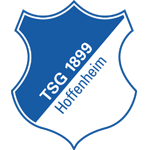
The shield is split diagonally into blue and white, the club colours, with the name TSG 1899 Hoffenheim written along the split. TSG stands for Turn- und Sportgemeinschaft, a gymnastics and sports club, and 1899 is the year the original gymnastics club was founded. The nickname comes from the Kraichgau, the region around the village of Hoffenheim.
Quiz clue: A blue-and-white shield with a pointed top and TSG 1899 Hoffenheim written diagonally.
Bayer Leverkusen
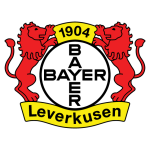
The Bayer cross in the middle is the logo of the Bayer company, whose works team the club began as in 1904. The players first wore it in 1936. Two red lions hold the cross like a shield. They are lions of the Bergisches Land, the animal on Bayer’s first company emblem. They carry the year 1904 and stand on a ribbon that reads Leverkusen.
Quiz clue: Two red lions either side of a round BAYER cross, with 1904 above and Leverkusen on a yellow ribbon.
Borussia Dortmund
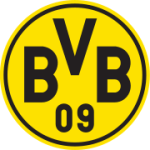
BVB stands for Ballspielverein Borussia, and 09 for the founding year, 1909. Borussia is Latin for Prussia, but the founders took the name from a beer brewed by the nearby Borussia brewery. The black letters on a yellow disc use the club colours. The design goes back to the 1920s, and the present version dates from 1993.
Quiz clue: A yellow disc with BVB in heavy black letters, the V raised, and 09 underneath.

Borussia Mönchengladbach
A tall black-and-white diamond holds a large B for Borussia. The name is a Latin form of Prussia and was a popular choice for clubs in the former Kingdom of Prussia. Black and white are the club colours. Between 1970 and 1999 the diamond sat on a green rectangle. Since then the club has used the diamond on its own.
Quiz clue: A black-and-white diamond with a B. Werder Bremen’s diamond is green with a W, and Hamburg’s has no letter.
Eintracht Frankfurt
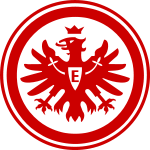
The eagle comes from the coat of arms of Frankfurt, which goes back to the one-headed imperial eagle of the 13th century. Red and white are the colours of the city arms. For some years the club used a stylised black-and-white eagle, but in its centenary year, 1999, it returned to a more traditional one, with a crown and an E on its chest.
Quiz clue: A red eagle with spread wings and a crown, on a white disc inside a red ring.
FC Augsburg
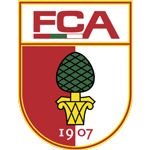
The lower field copies the arms of the city of Augsburg: a green pine cone on a gold column capital, on a red-and-white split background. Below it is the founding year, 1907. The initials FCA sit above, underlined in the club colours red, green and white. The 2002 crest is a reworking of the one used from 1969 to 1996.
Quiz clue: Red FCA lettering above a green pine cone on a red-and-white shield.
Bayern Munich
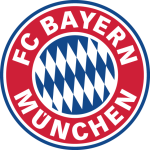
The blue-and-white lozenges in the centre come from the flag of Bavaria and first appeared on the crest in 1954. A red ring around them carries the club name in white. The present drawing dates from 2017. In October 2024 the club made the red and blue slightly lighter for better contrast.
Quiz clue: A red ring reading FC BAYERN MÜNCHEN around a centre of blue-and-white diamonds.

Schalke 04
The white S and 04 stand for Schalke, a district of Gelsenkirchen, and the founding year, 1904. Since 1945 they have sat inside a stylised G for Gelsenkirchen. In 1958 the G was redrawn so that it also forms a miner’s mallet, a reminder of the club’s early years among the coal mines. The present version dates from 1995.
Quiz clue: A round royal blue badge with a tall white S above 04, framed by a blue G shape.

Hamburger SV
A white square stands on its point on a blue field, with a black square inside it. Blue and black were the colours of SC Germania, one of the clubs that formed HSV. The diamond is borrowed from a symbol common in Hamburg’s merchant shipping, and the Blue Peter signal flag is said to have been a model. The design has barely changed in over a century.
Quiz clue: A black-and-white diamond on a plain blue rectangle, with no letters or numbers at all.

RB Leipzig
Two red bulls charge at a football above the name RB Leipzig. RB stands for RasenBallsport. The club played its first season, 2009–10, without a crest because the Saxony FA rejected designs that looked too much like the Red Bull company logo. The 2014 crest was a compromise with the German Football League: a football replaced the yellow sun.
Quiz clue: Two red bulls head to head with a football between them, on a white shield.

SC Freiburg
The upright oval is split diagonally. The white half shows the head of a griffin, the club’s heraldic animal, and the black half carries the interlaced initials SCF for Sport-Club Freiburg. The club’s official colours are white and red, but the badge itself is black and white.
Quiz clue: A black-and-white oval with a beaked griffin head on the left and a round SCF monogram on the right.

SC Paderborn 07
The round badge writes out the club name: SC and PADERBORN in black on white, above a black bar, and a white 07 on blue below. Blue and black are the club colours. The 07 stands for 1907, the founding year of TuS Neuhaus, one of the two clubs that merged in 1985. The club took its present name in 1997.
Quiz clue: A blue-and-white circle with PADERBORN in black italic capitals and a black bar that runs out past the right edge.

SV Elversberg
The interlaced black letters S, V and E stand for Sportvereinigung Elversberg and sit on a white disc inside a black ring. Black and white are the club colours. The club was founded in 1907 in Elversberg, part of the Saarland municipality of Spiesen-Elversberg. This monogram badge has been in use since 2021.
Quiz clue: A black-and-white roundel with a looping SVE monogram and no other text.

VfB Stuttgart
The three black antlers on gold come from the arms of Württemberg and have been a club symbol since 1909. The red VfB lettering in Gothic script was drawn by the painter and VfB player Hermann Stammler and first used in 1924, and 1893 is the founding year. This crest was used from 1949 to 1994 and returned in 2014 after a members’ vote.
Quiz clue: Red Gothic VfB letters and 1893 above three black antlers on a yellow field.
Werder Bremen
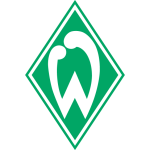
A white W for Werder stands on a green diamond, in the club colours. The Bremen graphic artist Günther Bruckmeyer drew the first stylised W in 1924. In 1929 the oval around it gave way to a diamond, the form the badge still has. The current version has been used since 1981. Werder is a German word for land beside a river.
Quiz clue: A green diamond with a rounded white W. Mönchengladbach’s diamond is black and white with a B.
Sources
Each entry was checked against the club’s official website or its Wikipedia article in November 2026. Crests are trademarks of their clubs and appear here only to identify them.
- 1. FC Köln: de.wikipedia.org
- 1. FC Köln: fc.de
- Union Berlin: de.wikipedia.org
- Union Berlin: en.wikipedia.org
- Mainz 05: en.wikipedia.org
- Mainz 05: www.horizont.net
- Hoffenheim: en.wikipedia.org
- Hoffenheim: de.wikipedia.org
- Bayer Leverkusen: de.wikipedia.org
- Bayer Leverkusen: en.wikipedia.org
- Borussia Dortmund: en.wikipedia.org
- Borussia Dortmund: de.wikipedia.org
- Borussia Mönchengladbach: en.wikipedia.org
- Borussia Mönchengladbach: www.diefalsche9.de
- Eintracht Frankfurt: en.wikipedia.org
- Eintracht Frankfurt: de.wikipedia.org
- FC Augsburg: de.wikipedia.org
- FC Augsburg: en.wikipedia.org
- Bayern Munich: en.wikipedia.org
- Bayern Munich: ran.joyn.de
- Schalke 04: de.wikipedia.org
- Schalke 04: en.wikipedia.org
- Hamburger SV: de.wikipedia.org
- Hamburger SV: en.wikipedia.org
- RB Leipzig: en.wikipedia.org
- RB Leipzig: de.wikipedia.org
- SC Freiburg: de.wikipedia.org
- SC Freiburg: www.diefalsche9.de
- SC Paderborn 07: en.wikipedia.org
- SC Paderborn 07: de.wikipedia.org
- SV Elversberg: de.wikipedia.org
- SV Elversberg: en.wikipedia.org
- VfB Stuttgart: de.wikipedia.org
- VfB Stuttgart: en.wikipedia.org
- Werder Bremen: en.wikipedia.org
- Werder Bremen: de.wikipedia.org