
Brazilian badges are often built around the club’s initials, drawn as interlaced monograms such as CRF, FFC, SCI or CAM. Many also borrow from their state: Bahia and Corinthians put a state flag at the centre, and Coritiba’s green and white come from the flag of Paraná. Stars above a crest usually mark a title, and several clubs have added or removed them over the years.
This guide describes the crests used in the 2026 season. Where sources disagree about a date or a detail, we leave it out rather than guess.
The clubs below are the 20 teams in the 2026–27 season, in alphabetical order. Each entry says what is on the badge, when the current design arrived and one detail that helps in a quiz.
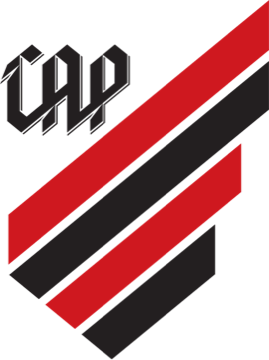
Athletico Paranaense
The badge is a set of red and black diagonal stripes with the letters CAP above them and no border. The club says the shape suggests a hurricane, after its nickname Furacão, and also draws on the flag of Paraná and the idea of growth. It was unveiled in December 2018 and used from 2019, replacing a round crest with vertical stripes. The gold and silver stars for the 2001 and 1995 titles were dropped, and the club went back to its original spelling, Club Athletico Paranaense.
Quiz clue: Red and black diagonal bars under angular CAP letters, with no circle or shield. Older images show the round crest with vertical stripes used until 2018.

Atlético Mineiro
The pointed shield carries the initials CAM, for Clube Atlético Mineiro, in white on a black band at the top, with black-and-white vertical stripes below. The club’s first emblem, from the 1910s, was just the three letters in an oval. The shield with letters above and stripes below was adopted in 1922, and only its exact shape and the placing of the stripes have changed since. The gold star above marks the 1971 Brazilian title. Red stars for later cup wins were removed in 1999.
Quiz clue: A black-and-white striped shield with CAM across the top and one gold star. Santos’s striped shield has S.F.C. on a diagonal band instead.
Bahia
Raimundo Magalhães designed the round badge, basing it on the Corinthians badge of the time. He changed the colours to blue and red, put a flag like that of Bahia state in place of the São Paulo flag, and used the club’s founding year, 1931. The name Esporte Clube Bahia runs around the ring. Blue, red and white are also the colours of the state flag, which is why the club calls itself the Tricolor Baiano. The two stars above mark the Brazilian titles of 1959 and 1988.
Quiz clue: A light-blue ring around a red-and-white striped flag, with 1931 below and two gold stars above. Corinthians also has a flag in a circle but adds an anchor and oars.

Botafogo
A white five-pointed star sits on a black shield with a white inner and a black outer border. The star comes from Club de Regatas Botafogo, the rowing club, whose rowers trained at dawn on Botafogo Bay and often saw Venus, the morning star. The shield shape comes from Botafogo Football Club, whose founder Basílio Viana Júnior drew it in ink with the letters BFC. When the two clubs merged in 1942, the star took the place of the letters. Four smaller stars sat above the crest from 1981 to 2003.
Quiz clue: A single white star on a plain black shield, with no letters at all.

Chapecoense
The green-and-white roundel holds the monogram ACF, with the full name Associação Chapecoense de Futebol around the ring and the city, Chapecó-SC, at the bottom. Green and white are also the colours of the Chapecó city flag. Apart from the number of stars, the badge changed little until 2017. That year the club placed a star inside the F in memory of the victims of the November 2016 air crash in Colombia, and a white star above the crest for the 2016 Copa Sudamericana.
Quiz clue: A green ring with ACF in white and one star above. Coritiba’s green roundel shows CFC on a globe.

Corinthians
At the centre is a round disc with the flag of São Paulo state, a feature since 1919, inside a ring with the club name and the year 1910. The anchor and two oars were added in 1939 by the modernist painter Francisco Rebolo, a former reserve player, to mark the club’s success in water sports. In the current drawing by the artist Orfeu Maia, a rope replaces the old life buoy around the disc. Stars for national and world titles were added from 1990 and all removed in 2011.
Quiz clue: A red anchor and crossed oars behind a round black-and-white flag. Bahia’s round badge is blue and has no anchor.

Coritiba
The club statute describes the badge as a globe, with ribbed bands at the top and bottom that suggest the polar ice caps and the initials CFC in the middle. Around it, between two lines, runs the full name Coritiba Foot Ball Club, with PARANÁ at the bottom. Green and white come from the Paraná state flag. The gold star above marks the 1985 Brazilian title, the first won by a club from Paraná. A plan to simplify the crest was shown in January 2023 but was put on hold.
Quiz clue: A green globe with CFC in the middle, the club name around it and one gold star. Chapecoense’s green roundel has an ACF monogram.

Cruzeiro
Five white stars on a blue disc form the Southern Cross, the constellation called Cruzeiro do Sul in Portuguese, which gave the club its name in 1942 and also appears on the flag of Brazil. A white ring carries the name Cruzeiro Esporte Clube. The club began as Palestra Itália, with green, red and white badges. A crown added after the 2003 treble was taken off the main crest in 2021, the club’s centenary, when the blue was also standardised. The stars are often worn alone on the shirt.
Quiz clue: Five white stars on a blue circle, with the club name in a white ring.
Flamengo
The shield is filled with horizontal red and black stripes, with a red square in the top corner holding the white monogram CRF, for Clube de Regatas do Flamengo. The club was founded for rowing in 1895 and still keeps a separate rowing crest. Most changes over the years have been to the monogram, and the latest redesign, published in April 2018, adjusted the letters and some colours and outlines.
Quiz clue: Red and black horizontal stripes on a shield, with a small white CRF in the corner. Athletico’s stripes are diagonal and have no shield.
Fluminense
The interlaced letters FFC, for Fluminense Football Club, are drawn in Gothic, Old English style lettering on a shield split into maroon above and green below. The shape follows Swiss shields of the 18th and 19th centuries, which is linked to the founder Oscar Cox, who had studied in Switzerland. The club statute names the colours as encarnado, white and green, though the red is usually called grená, or maroon. The name comes from the Latin flumen, river, and also describes people from Rio de Janeiro state.
Quiz clue: A maroon-and-green shield with ornate white Gothic FFC letters. Vitória’s similar monogram sits on red and black.
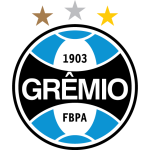
Grêmio
The round badge is drawn like an old football, with light blue panels at the top and bottom and a black band across the middle that carries the word GRÊMIO. The founding year, 1903, sits above and FBPA, for Foot-Ball Porto Alegrense, below. The first emblem, in blue and white, soon gave way to a ball-shaped crest, and the 1920 version copied the footballs of the time. The name moved to the centre in 1963, and the double white and black outline came in the 1980s. The bronze, silver and gold stars above were first added for the 1981 Brazilian title and the 1983 Libertadores and Intercontinental Cup, and now stand for national, continental and world titles.
Quiz clue: A blue, black and white ball with GRÊMIO across it and three stars in bronze, silver and gold.

Internacional
The interlaced white initials SCI, for Sport Club Internacional, sit on a red disc. The first badge had red initials on white, and the colours were reversed in the 1950s. Over the years the club added stars, a crown and laurels for its titles. For the centenary in 2009 it removed all of them and added the outer ring that carries the name S.C. Internacional and the founding year, 1909.
Quiz clue: A red circle with large interlaced white SCI letters and 1909 at the bottom.
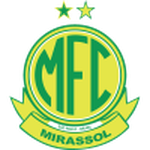
Mirassol
The badge is built from the initials MFC, for Mirassol Futebol Clube, in green on a yellow disc with a green ring, above a ribbon that carries the name Mirassol, with two small stars, one green and one yellow, above the disc. Green and yellow are the club colours. After a 1964 merger with a local rival, GREC, the club played as Mirassol Atlético Clube in blue and white. When that partnership ended in 1981 it took back its original name and colours. The club reached Série A for the first time in 2025.
Quiz clue: Tall green MFC letters on a yellow circle, with MIRASSOL on a ribbon underneath and two small stars on top.
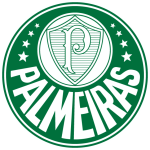
Palmeiras
A small Swiss-style shield with the letter P sits in a white circle at the top of a green disc, above the name PALMEIRAS in large white letters, with four small white stars on each side. The club says the eight stars refer to August, the month Palestra Italia was founded. The club began as Palestra Italia, and its early badges paired the letters P and I, at times in green, white and red. When the club became Palmeiras in 1942, the red and the I disappeared, leaving green and white. In 2012 the club standardised the drawing, rounding the lettering and slightly adjusting the P.
Quiz clue: A green circle with PALMEIRAS in big curved letters under a small P shield, flanked by eight small stars. Coritiba’s green roundel has CFC on a globe.
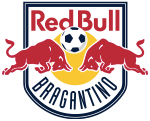
RB Bragantino
On a white shield with a dark blue edge, two red bulls charge at a football in front of a yellow disc, with Red Bull in red lettering above and BRAGANTINO in dark blue below. The energy drink company took over Clube Atlético Bragantino in 2019, and from 2020 the club was renamed Red Bull Bragantino with a completely new crest, revealed on 1 January 2020. It replaced the old Bragantino badge and closely follows the earlier Red Bull Brasil logo, in line with the group’s other clubs such as RB Leipzig and Red Bull Salzburg.
Quiz clue: Two red bulls and a football above BRAGANTINO. RB Leipzig uses the same bulls with no Bragantino lettering.

Remo
The badge is a navy blue shield with a white edge and the interlaced white initials CR, for Clube do Remo. The club’s first flag, in 1905, showed a white anchor and thirteen stars on navy blue. After a reorganisation in 1911 the badge became a ring like a life buoy, crossed by oars, with the letters GR for Grupo do Remo. In 1914 the name changed to Clube do Remo, the letters became CR, and the shield gained the rounded side cut-outs the club links to British heraldry.
Quiz clue: A plain dark navy shield with a large white CR monogram and nothing else.
Santos
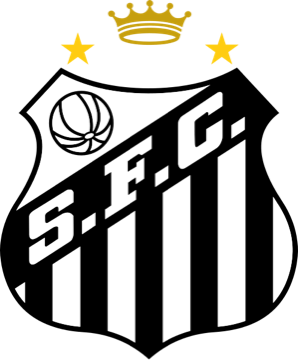
The shield shape dates from 1925 and was first worn on the shirt in 1927. A black diagonal band carries the letters S.F.C., for Santos Futebol Clube, with an old leather football in the top corner, and the black-and-white stripes below are said to stand for the eleven players. The two stars above mark the 1962 and 1963 Intercontinental Cups. In late 2022 the club added a crown between them in permanent honour of Pelé, as set out in its new statute.
Quiz clue: Black-and-white stripes under a diagonal S.F.C. band, with a small crown between two stars. Atlético Mineiro’s striped shield has CAM across the top.
São Paulo
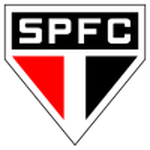
A black rectangle with the initials SPFC in white sits on top of an inverted white triangle, which holds a red and a black triangle split by a white bar. The German graphic designer Walter Ostrich drew it with one of the club’s founders. Red, white and black came from the two clubs that merged in 1930, Club Athletico Paulistano and Associação Atlética das Palmeiras. The version shown here has no stars. The club also uses one with five stars: two gold for Adhemar Ferreira da Silva’s athletics records and three red for world club titles.
Quiz clue: A white shield with SPFC on a black bar above red and black triangles, with no stars.

Vasco da Gama
A Portuguese caravel sails across a black shield cut by a white diagonal band, with a red cross on its sail and the initials CRVG, for Club de Regatas Vasco da Gama. The club honours the navigator and the Portuguese voyages of discovery. Fans call the cross the Maltese cross, but it is a cross pattée, and the original was the Cross of the Order of Christ. Black stands for the unknown seas to the East and white for the route to India. This form of the crest dates from the 1920s.
Quiz clue: A sailing ship with a red cross on its sail, on a black shield with a white diagonal band.
Vitória
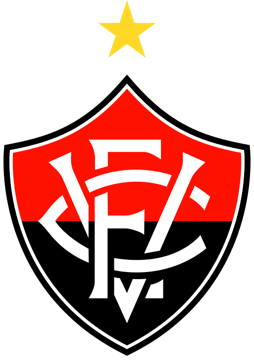
A shield split red over black holds the interlaced white initials of Esporte Clube Vitória. The club was founded in Salvador in 1899 for cricket. A shield in the medieval Swiss style, black with a white SCV monogram, was first recorded in 1934, and from the late 1940s the design moved towards the one used today. The colours began as black and white before red replaced white. In November 2023 members voted to add a gold star above the crest for the 2023 Série B title.
Quiz clue: A red-and-black shield with a looping white monogram and one gold star. Fluminense’s Gothic monogram sits on maroon and green.
Sources
Each entry was checked against the club’s official website or its Wikipedia article in November 2026. Crests are trademarks of their clubs and appear here only to identify them.
- Athletico Paranaense: pt.wikipedia.org
- Athletico Paranaense: en.wikipedia.org
- Athletico Paranaense: www.goal.com
- Atlético Mineiro: en.wikipedia.org
- Atlético Mineiro: pt.wikipedia.org
- Bahia: pt.wikipedia.org
- Bahia: en.wikipedia.org
- Botafogo: pt.wikipedia.org
- Botafogo: en.wikipedia.org
- Chapecoense: pt.wikipedia.org
- Chapecoense: www.estadao.com.br
- Corinthians: en.wikipedia.org
- Corinthians: pt.wikipedia.org
- Coritiba: pt.wikipedia.org
- Coritiba: www.umdoisesportes.com.br
- Cruzeiro: en.wikipedia.org
- Cruzeiro: pt.wikipedia.org
- Flamengo: en.wikipedia.org
- Flamengo: pt.wikipedia.org
- Flamengo: www.gazetaesportiva.com
- Fluminense: pt.wikipedia.org
- Fluminense: en.wikipedia.org
- Grêmio: pt.wikipedia.org
- Grêmio: en.wikipedia.org
- Internacional: en.wikipedia.org
- Internacional: pt.wikipedia.org
- Mirassol: pt.wikipedia.org
- Mirassol: en.wikipedia.org
- Palmeiras: pt.wikipedia.org
- Palmeiras: palmeiras.com.br
- Palmeiras: en.wikipedia.org
- RB Bragantino: en.wikipedia.org
- RB Bragantino: pt.wikipedia.org
- RB Bragantino: www.tupi.fm
- RB Bragantino: footyheadlines.com
- Remo: pt.wikipedia.org
- Remo: en.wikipedia.org
- Santos: pt.wikipedia.org
- Santos: en.wikipedia.org
- São Paulo: pt.wikipedia.org
- São Paulo: en.wikipedia.org
- Vasco da Gama: en.wikipedia.org
- Vasco da Gama: pt.wikipedia.org
- Vitória: pt.wikipedia.org
- Vitória: www.bahianoticias.com.br