
Many crests in the 2026–27 league phase borrow from national and regional symbols: Slovan Bratislava carries the double cross of Slovakia’s coat of arms, AEK Athens the double-headed eagle of Byzantium, Bayern the lozenges of the Bavarian flag and VfB Stuttgart the antlers of Württemberg. Gold stars count league titles at Club Brugge, Slavia Prague and Galatasaray, and founding years such as Brugge’s 1891, Viking’s 1899 and Shakhtar’s 1936 are written into the design.
This guide covers the clubs that do not appear in our league guides; the other clubs link to their entries there. It describes the crests used in the 2026–27 season. Where sources disagree about a date or a detail, we leave it out rather than guess.
The clubs below are the 11 teams in the 2026–27 season, in alphabetical order. Each entry says what is on the badge, when the current design arrived and one detail that helps in a quiz.

AEK Athens
A black double-headed eagle fills a yellow shield, with the letters Α.Ε.Κ. in a white band above it and F.C. below. Each head wears a crown, and the eagle holds a sword in one claw and an orb with a cross in the other. AEK, the Athletic Union of Constantinople, was founded in Athens in 1924 by Greek refugees from Constantinople. They took the eagle, an emblem of the Palaiologos dynasty and the Byzantine Empire, and the colours yellow and black as reminders of the homeland they had lost.
Quiz clue: A crowned black double-headed eagle on a yellow shield under Greek letters. PAOK also uses a double-headed eagle, but in black and white.
Bodø/Glimt
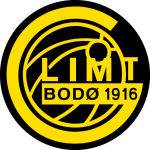
A thick yellow letter G curves around a black disc, and inside it the letters LIMT complete the word GLIMT. A yellow bar beneath reads BODØ 1916, and thin yellow lines cross the black background behind the letters. The club was founded in Bodø in 1916 simply as Glimt, which means gleam. A club in Orkdal already had that name, so in 1948 it became Bodø-Glimt, and many people in the town still call it Glimt. Yellow is also the colour of its supporters, who carry a giant yellow toothbrush.
Quiz clue: A black disc with a large yellow G that runs into the word GLIMT, above BODØ 1916.
Club Brugge
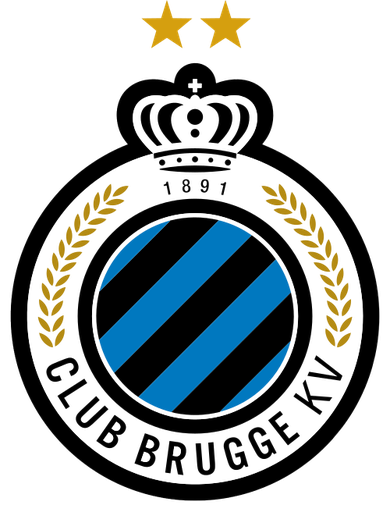
Diagonal blue and black stripes, the club colours since 1909, fill a disc in the centre. Around it a white ring carries gold laurel branches and the name CLUB BRUGGE KV, and a crown sits on top above 1891, the year the club counts as its foundation. KV stands for Koninklijke Voetbalvereniging, royal football club, and the royal title dates from 1920. Two gold stars float above the crown, one for every ten league titles. The first was added in 2017 and the second followed the twentieth title in 2026.
Quiz clue: A blue-and-black striped disc inside a white ring, with a crown and two gold stars on top.
Fenerbahçe
A white ring carries the name FENERBAHÇE SPOR KULÜBÜ and the year 1907 between two small black stars. Inside, a shield split into navy and yellow bands has a green oak branch rising through it, and red fills the space on either side. The footballer Hikmet Topuzer drew the design. By the usual reading, the red stands for the Turkish flag, the white for purity, the navy for nobility and the oak for strength. The club was founded in 1907 in Kadıköy, Istanbul.
Quiz clue: A round badge with a navy-and-yellow shield and a green oak branch inside a red frame. Galatasaray’s crest is a red G and yellow S under five stars.
Galatasaray
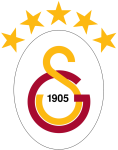
The crest is two interlocked letters, a yellow S and a red G, on a white oval, with the founding year 1905 inside the curve of the G. They stand for Galata Saray. Ayetullah Emin designed the monogram in the 1920s in the Arabic letters ghayn and sin, which became G and S when Turkey adopted the Latin alphabet. Red and yellow have been the club colours since 1908. Five gold stars sit above the oval. In Turkey each star marks five league titles, and the fifth came with the 25th title in 2025.
Quiz clue: Interlocked yellow S and red G with 1905, under five gold stars. Fenerbahçe’s round badge has a shield and an oak branch instead.
LASK
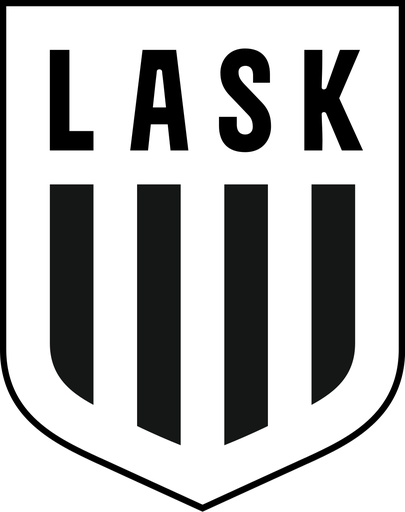
The badge is a plain white shield with a straight top edge. LASK is written across it in tall black capitals, and four black vertical stripes fill the lower part, in the club colours black and white. LASK stands for Linzer Athletik-Sport-Klub, from Linz. The club introduced this simplified badge in May 2023, with lettering developed from the four letters on the club flag. The round crest that used to sit at the top of the shield is now used as a separate logo.
Quiz clue: A black-and-white shield with LASK in tall letters over four black stripes, and no other symbol.
Sabah
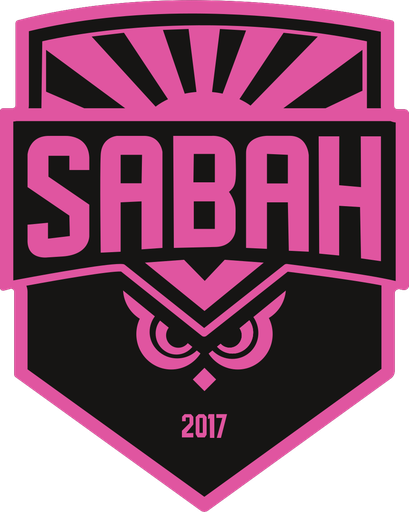
A black shield edged in pink carries the name SABAH in large pink letters on a band across the middle. Pink sun rays fan out above the name, and below it a pink owl’s face sits over the founding year, 2017. Sabah means tomorrow, and the club was founded on 8 September 2017. The rays are meant to stand for a new day, new hopes and new victories, and the shield for the will to defend. Black and pink are the club colours, and the owl matches its nickname.
Quiz clue: A black-and-pink shield with sun rays above SABAH and an owl’s face below it.
Shakhtar Donetsk
A pointed oval is split into an orange top and a black bottom by the name ШАХТАР, the Ukrainian word for a miner. Above the name rises a black-and-white flame shape, which also echoes the Ukrainian trident and the letter Ш. Below it are the founding year, 1936, and a crossed hammer and pick for the miners’ work. Black and orange, the official colours since 1961, stand for coal and the fire that comes from it. The crest was unveiled in December 2007, the first to spell the name in Ukrainian.
Quiz clue: An orange-and-black pointed oval with ШАХТАР in Cyrillic letters and a small crossed hammer and pick.
Slavia Prague
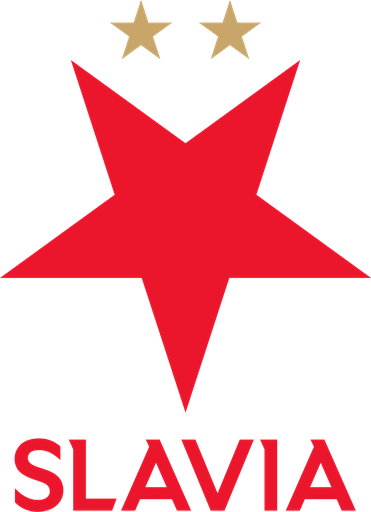
Since July 2022 the crest has been a large red five-pointed star pointing downwards, with the word SLAVIA beneath it and two small gold stars above. Each gold star marks ten league titles. A red star has sat on the white half of the club’s red-and-white shirt from the very start. When the colours were chosen in 1895, red was meant for the heart, white for fair play and the star for a new hope that lifts the spirit. The new crest shortened the name from SK Slavia Praha to Slavia.
Quiz clue: A big red star with one point down, two small gold stars above it and SLAVIA below.

Slovan Bratislava
A light-blue five-sided shield frames the words SLOVAN and BRATISLAVA. In the centre a red disc carries a white double cross standing on blue three-peaked hills, the same elements as the coat of arms of Slovakia, where the peaks stand for the Tatra, Fatra and Matra ranges. Three gold stars sit above the shield. The club was founded in 1919 and has been called Slovan, meaning Slav, since 1953. It has won more league titles than any other Slovak club.
Quiz clue: A sky-blue pentagon with a white double cross on a red disc, under three gold stars.
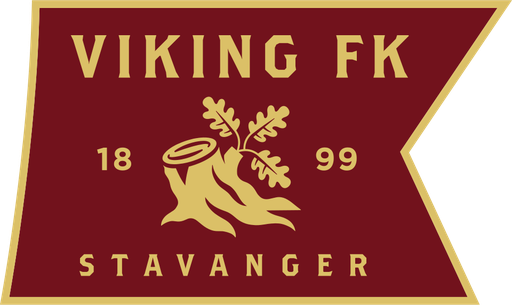
Viking
The badge is shaped like a flag with a notched end, dark red with a thin gold border and gold lettering: VIKING FK at the top and STAVANGER at the bottom. In the middle a tree stump sprouts oak leaves, with the founding year split either side as 18 and 99. The club was founded in Stavanger in 1899 and has always used a flag-shaped badge. It redrew the badge in January 2020 with a new typeface and stump and a dark blue background, but the red background returned in 2022.
Quiz clue: A dark red flag with a notched end, gold VIKING FK lettering and a sprouting oak stump.
Clubs explained in our league guides
These clubs have full entries in the guide to their own league.
- Arsenal Premier League badges explained
- Aston Villa Premier League badges explained
- Atlético de Madrid La Liga badges explained
- Bayern Munich Bundesliga badges explained
- Borussia Dortmund Bundesliga badges explained
- Como Serie A badges explained
- FC Barcelona La Liga badges explained
- Feyenoord Eredivisie badges explained
- Inter Serie A badges explained
- Lens Ligue 1 badges explained
- Lille Ligue 1 badges explained
- Liverpool Premier League badges explained
- Manchester City Premier League badges explained
- Manchester United Premier League badges explained
- Napoli Serie A badges explained
- PSV Eredivisie badges explained
- Paris Saint-Germain Ligue 1 badges explained
- Porto Primeira Liga badges explained
- RB Leipzig Bundesliga badges explained
- Real Betis La Liga badges explained
- Real Madrid La Liga badges explained
- Roma Serie A badges explained
- Sporting CP Primeira Liga badges explained
- VfB Stuttgart Bundesliga badges explained
- Villarreal La Liga badges explained
Sources
Each entry was checked against the club’s official website or its Wikipedia article in November 2026. Crests are trademarks of their clubs and appear here only to identify them.
- AEK Athens: en.wikipedia.org
- AEK Athens: el.wikipedia.org
- Bodø/Glimt: en.wikipedia.org
- Bodø/Glimt: no.wikipedia.org
- Club Brugge: en.wikipedia.org
- Club Brugge: nl.wikipedia.org
- Club Brugge: sporza.be
- Fenerbahçe: en.wikipedia.org
- Fenerbahçe: en.wikipedia.org
- Fenerbahçe: www.iscihaber.net
- Galatasaray: en.wikipedia.org
- Galatasaray: tr.wikipedia.org
- Galatasaray: www.goal.com
- Galatasaray: sporza.be
- LASK: en.wikipedia.org
- LASK: de.wikipedia.org
- LASK: www.tips.at
- Sabah: en.wikipedia.org
- Sabah: az.wikipedia.org
- Sabah: sabahfc.az
- Shakhtar Donetsk: en.wikipedia.org
- Shakhtar Donetsk: uk.wikipedia.org
- Slavia Prague: en.wikipedia.org
- Slavia Prague: cs.wikipedia.org
- Slavia Prague: www.mediaguru.cz
- Slovan Bratislava: en.wikipedia.org
- Slovan Bratislava: sk.wikipedia.org
- Slovan Bratislava: en.wikipedia.org
- Viking: en.wikipedia.org
- Viking: no.wikipedia.org
- Viking: www.vikingfotball.no