
Championship badges lean on local history. Town and city arms supply lions, roses and stars, nicknames supply robins, canaries, rams and imps, and several crests began as winning entries in newspaper or supporter competitions. Many clubs also print their founding year, and a few have recently gone back to designs from the 1970s and 1980s.
This guide describes the crests used in the 2026–27 season. Where sources disagree about a date or a detail, we leave it out rather than guess.
The clubs below are the 24 teams in the 2026–27 season, in alphabetical order. Each entry says what is on the badge, when the current design arrived and one detail that helps in a quiz.
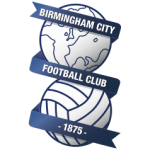
Birmingham City
A globe and a football sit one above the other, held together by a ribbon carrying the club name and the founding year, 1875. The design won a competition run by the Sports Argus newspaper in 1972 and was drawn by the supporter Michael Wood. The club’s commercial manager said the globe brought in the idea of European football. It was first worn on the shirts in 1976. A badge with the initials BCFC was worn for the 2015–16 season only, to mark the club’s 140th anniversary.
Quiz clue: A blue-and-white globe stacked on a football, with a ribbon wrapped across the middle.
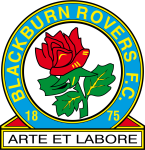
Blackburn Rovers
A red rose with green leaves sits in a white circle, inside a blue ring lettered in yellow with BLACKBURN ROVERS F.C. and the founding year, split as 18 and 75. The rose is the red rose of Lancashire. A banner below carries the motto Arte et Labore, by skill and hard work, taken from the town motto adopted in 1852. The club first put a Lancashire rose on its shirts in 1974, with B.R.F.C. beneath it. That dark red rose was hard to see on the blue shirt, and the current badge replaced it in 1989. Before then the club wore the town’s coat of arms only for FA Cup finals, the last in 1960.
Quiz clue: A red rose in a white circle inside a blue ring, above an ARTE ET LABORE banner. Bolton’s rose is small and sits under BWFC letters.

Bolton Wanderers
The initials BWFC are drawn so that together they form a football. Below them is a red scroll with the red rose of Lancashire, and under the rose is 1877, the year the club took the name Bolton Wanderers. The 2013 crest reworks a popular design from the 1970s. It brought back the rose, which a 2001 badge had swapped for blue and red ribbons. Before any of these, the club used the town crest of Bolton, with an elephant and castle.
Quiz clue: Blue BWFC letters curled into a ball above a small red rose.
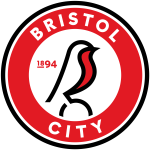
Bristol City
A robin, the bird behind the club’s nickname, stands inside a red-and-white roundel with BRISTOL CITY written around it and the founding year, 1894, beside the bird. A robin was on the badge from 1976 to 1994. Between 1994 and 2019 the club used a simplified version of the Bristol city arms instead. The robin returned in March 2019 after a consultation with supporters.
Quiz clue: A black-outlined robin in a red ring reading BRISTOL CITY.
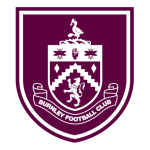
Burnley
The badge is based on the arms of the town of Burnley. A stork at the top stands for the Starkie family, and it holds the Lacy knot of the de Lacy family, who held Burnley in the Middle Ages. The hill and cotton plants recall the cotton trade. A hand stands for the town motto, Hold to the Truth, the bees for hard work, the lion for royalty and the wavy chevron for the River Brun. Since 2023 all of this has been drawn in white on a claret shield.
Quiz clue: A claret shield with white heraldry and a bird at the top. West Ham’s claret shield has crossed hammers instead.
Cardiff City
A bluebird inside a circle fills the middle of a white shield, with CARDIFF CITY FC in blue on a banner across the top. The bluebird follows the nickname, which comes from the blue-and-white kit the club has worn since 1908. A small red dragon sits at the foot. Its stance is taken from the Welsh flag and it was inspired by the dragon on Cardiff City Hall. The club says the shield shape recalls the arms worn in the 1927 FA Cup final. The crest was introduced for the 2015–16 season.
Quiz clue: A blue bird in a circle on a white shield with a small red dragon at the bottom. Swansea’s badge is a black swan.

Charlton Athletic
A hand holds an upright sword on a red disc, inside a black ring that reads CHARLTON ATHLETIC. The design won a club competition in 1963 and suited the nickname of the time, the Valiants. Over the next five years a circle and the club name were added, and the crest was first used in its current form in August 1968. In the 1970s the shirts carried only the letters CAFC. The more common nickname, the Addicks, is traced to a local fishmonger who treated the team to haddock and chips.
Quiz clue: A hand gripping a white sword on a red circle inside a black ring.

Derby County
The badge is a single line drawing of a ram. The ram is a symbol of Derby, and the nickname honours the club’s links with the First Regiment of Derby Militia. A ram was already on the club’s first badge in 1924. A more modern ram arrived in 1971 and, with changes to its direction and lettering over the years, is still in use. Since July 2013 the ram on its own has again been the full club logo.
Quiz clue: A whole white ram drawn in a black outline, with a curled horn and no shield or lettering.

Lincoln City
The badge is a sharp, angular drawing of the Lincoln Imp in the club colours, red and white. The Imp is a stone carving in Lincoln Cathedral and gives the club its nickname. The club says this version goes back to a fan favourite logo of the 1990s and was reintroduced as the main club logo ahead of the 2024–25 season after a supporters’ vote. Earlier crests used the city’s heraldic shield.
Quiz clue: A red angular imp with pointed horns, drawn in outline with no shield around it.
Middlesbrough
A red lion rampant stands inside a roundel, with MIDDLESBROUGH FOOTBALL CLUB around it and the founding year, 1876, split either side of the lion. The lion comes from the town’s own crest. Two Teesside landmarks are hidden in it: the River Tees as it meets the Riverside Stadium forms the tongue, and the outline of Roseberry Topping sits in the mane. The club announced the crest in October 2025 and uses it from 2026–27, its 150th season. A gold anniversary version is used for this season only.
Quiz clue: A red lion on its hind legs in a red-and-white circle. Millwall’s roundel is navy with a grey lion.
Millwall
A single leaping lion sits on a navy blue disc, ringed by the words Millwall Football Club and the founding year, 1885. A lion has been the club’s symbol since 1936, and the nickname followed newspaper headlines calling the team the Lions of the South after an FA Cup run in 1899–1900. The leaping lion first appeared on the kit in 1979. The club went back to an older badge in 1999 and brought the leaping lion back in 2007.
Quiz clue: A grey leaping lion on a navy circle. Middlesbrough’s lion is red and upright.
Norwich City
A yellow canary rests on a football, with a version of the City of Norwich arms, a castle above a lion, in the top left corner. The canary comes from the nickname, which reflects the history of canary breeding in the area. A simple canary badge was first adopted in 1922. A redrawn version, with a simpler castle, lion and canary and the ball moved towards the centre, was revealed in November 2021 and used on all club branding from June 2022.
Quiz clue: A yellow canary standing on a yellow ball, on a green shield with a castle in the corner.
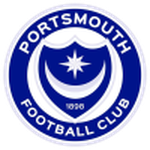
Portsmouth
An eight-pointed star sits above a crescent moon on a blue shield, with the founding year, 1898, beneath, all inside a blue ring reading PORTSMOUTH FOOTBALL CLUB. Both come from the coat of arms of the city of Portsmouth, and the city council granted the club their use from 1913 without the club owning them. Because the motifs could not be protected as club property, the club introduced two redrawn badges for 2018–19, one mainly for the shirt and one for commercial use. Both keep the star and crescent.
Quiz clue: A white star and crescent on a blue shield inside a blue ring, with no animal or initials.

Preston North End
A lamb with a banner sits above the words PRESTON NORTH END FC on a white shield with a blue border. The lamb is taken from the coat of arms of the town of Preston and is the lamb of St Wilfrid, Preston’s patron saint. Preston are also remembered as the Invincibles, the side that went unbeaten through the league in 1888–89 and won the FA Cup without conceding a goal.
Quiz clue: A small blue lamb and flag above PRESTON NORTH END in blue capitals on a white shield.

Queens Park Rangers
The round badge has the initials QPR joined in a single blue monogram in the centre, with the club name around it and the founding year, 1882, at the foot, all in blue and white. It was unveiled in May 2016 after a six-month supporter consultation in which most fans asked for a simpler design. It replaced a crest introduced under Flavio Briatore in 2008. Older motifs, such as the horseshoe and the crown, were left out.
Quiz clue: A blue-and-white circle with a looping QPR monogram and QUEENS PARK RANGERS around the edge.
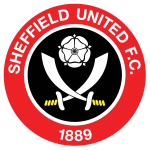
Sheffield United
Two white crossed swords, or blades, sit below a white Yorkshire rose on a black circle, inside a red ring with Sheffield United F.C. and the founding year, 1889. The blades refer to Sheffield’s history as the major producer of cutlery, which also gave the club its nickname. The design is credited to the former player Jimmy Hagan and was introduced by the manager Jimmy Sirrel, replacing the city arms. After some variations the crest went back to its original form in 2000.
Quiz clue: Two crossed white swords and a white rose on a black circle in a red ring. Sheffield Wednesday use an owl.
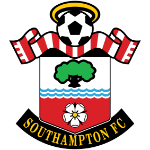
Southampton
A football with a halo above it sits over a red-and-white scarf, a tree, water and a white rose on a shield. The halo stands for the nickname, which goes back to the club’s start as a church team at St Mary’s Church. The ball stands for the game, the scarf for the fans, the tree for the New Forest and Southampton Common, and the water for the city’s links to the sea. The white rose is the city’s symbol. The local designer Rolland Parris drew it for a 1974 fans’ competition.
Quiz clue: A haloed football above a red-and-white scarf and a small green tree, with SOUTHAMPTON FC on a ribbon.
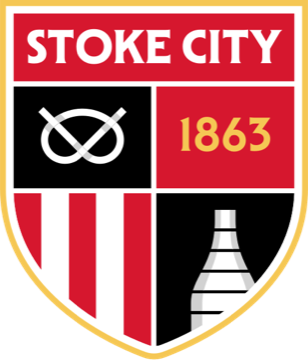
Stoke City
The shield is split into four. STOKE CITY runs across the top, above a Staffordshire knot, the founding year, 1863, red-and-white stripes and a bottle kiln. The kiln stands for the pottery industry of Stoke-on-Trent, which also gives the nickname. The design is based on the crest used from 1977 to 1992 and was drawn with the agency Drummond Central. Supporters approved the change by 68% to 32%, and it was unveiled in August 2025 for use from 2026–27.
Quiz clue: A four-part shield with a knot, a bottle-shaped kiln, red-and-white stripes and 1863 in gold.
Swansea City
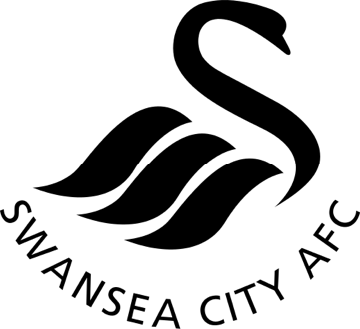
A black, stylised swan with a long curved neck sits above the words SWANSEA CITY AFC. The design dates from 1998, when the club replaced a bird that was not clearly a swan, set on a blue background, the colour of rivals Cardiff City. After anniversary and retro badges between 2021 and 2023, the 1998 swan returned in 2023. In 2026 supporters voted to make the swan without lettering the primary badge from the 2027–28 season.
Quiz clue: A black swan drawn in a few bold curves, with no shield or circle. Cardiff’s badge is a blue bird on a white shield.
Watford
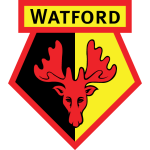
A red hart’s head sits on a diamond-shaped shield halved in yellow and black, under a strip bearing the name WATFORD. A hart is a male deer, and it represents the town’s place in the county of Hertfordshire. The hart replaced a hornet badge in 1978. The Hornets nickname dates from 1959, when supporters chose it after the club changed to yellow and black.
Quiz clue: A red deer’s head with antlers on a yellow-and-black diamond.
West Bromwich Albion
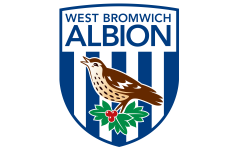
A speckled brown throstle, or song thrush, perches on a hawthorn branch with red berries, on a shield of navy blue and white stripes under the words WEST BROMWICH ALBION. The idea came from Tom Smith, who became club secretary in 1884 and suggested a throstle sitting on the crossbar of a goal. The team became widely known as the Throstles. Some time after the move to The Hawthorns in 1900, the crossbar was replaced by a hawthorn branch. The stripes follow the shirts the club has worn for most of its history.
Quiz clue: A brown thrush on a green branch with red berries, over navy-and-white stripes. Bristol City’s bird is a robin in a red ring.
West Ham United
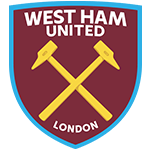
Two gold crossed hammers sit on a claret shield edged in blue, with WEST HAM UNITED above and LONDON below. They are rivet hammers from shipbuilding, recalling Thames Ironworks, the works team the club grew out of. The shape follows the hull of HMS Warrior, a warship built at the Ironworks. The badge was introduced when the club moved to the Olympic Stadium in 2016. It dropped the castle that stood for the Boleyn Ground.
Quiz clue: Gold crossed hammers on a claret shield with LONDON at the bottom.

Wolverhampton Wanderers
A black, angular wolf’s head sits on gold inside a black hexagon. Gold and black are the club colours and are linked to the city motto, Out of darkness cometh light. Before the wolf, the club used the arms of the County Borough of Wolverhampton on special occasions. A leaping wolf followed in the late 1960s and three leaping wolves in the mid-1970s. The wolf head arrived in 1979. The town arms came back on the shirts from 1993 to 1996, then the wolf head returned, and it was last redrawn in 2002. In 2019 a man who claimed to have drawn it as a schoolboy lost a copyright case against the club.
Quiz clue: A black wolf’s face with pointed ears on gold, framed by a black hexagon.
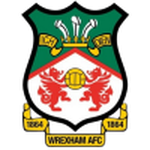
Wrexham
The badge has three parts. At the top are the Prince of Wales’s feathers and the motto Ich dien, I serve, on green. In the middle two dragons for Wales hold a football on white. Green and white are the colours of the Welsh flag. The club name and founding year sit at the bottom. The badge came from a 1973 competition in a local newspaper. Since 2015–16 the founding year has read 1864.
Quiz clue: Three white feathers on green above two red dragons holding a ball.
Sources
Each entry was checked against the club’s official website or its Wikipedia article in November 2026. Crests are trademarks of their clubs and appear here only to identify them.
- Birmingham City: en.wikipedia.org
- Birmingham City: www.wsc.co.uk
- Birmingham City: sportsmole.co.uk
- Blackburn Rovers: en.wikipedia.org
- Blackburn Rovers: www.worldsoccerpins.com
- Bolton Wanderers: en.wikipedia.org
- Bolton Wanderers: www.bwfc.co.uk
- Bristol City: en.wikipedia.org
- Bristol City: www.footyheadlines.com
- Burnley: en.wikipedia.org
- Burnley: www.footyheadlines.com
- Cardiff City: en.wikipedia.org
- Cardiff City: www.cardiffcityfc.co.uk
- Cardiff City: www.skysports.com
- Charlton Athletic: en.wikipedia.org
- Charlton Athletic: www.footballcrests.com
- Derby County: en.wikipedia.org
- Derby County: en.wikipedia.org
- Lincoln City: en.wikipedia.org
- Lincoln City: www.weareimps.com
- Lincoln City: cdn.weareimps.com
- Lincoln City: www.hellorayo.co.uk
- Middlesbrough: en.wikipedia.org
- Middlesbrough: fanbanter.co.uk
- Millwall: en.wikipedia.org
- Millwall: worldsoccerpins.com
- Norwich City: en.wikipedia.org
- Norwich City: canaries.co.uk
- Portsmouth: en.wikipedia.org
- Portsmouth: expressfm.com
- Preston North End: en.wikipedia.org
- Preston North End: worldsoccerpins.com
- Queens Park Rangers: en.wikipedia.org
- Queens Park Rangers: www.thescore.com
- Sheffield United: en.wikipedia.org
- Sheffield United: worldsoccerpins.com
- Southampton: en.wikipedia.org
- Southampton: www.wsc.co.uk
- Stoke City: en.wikipedia.org
- Stoke City: stoke.nub.news
- Swansea City: en.wikipedia.org
- Swansea City: www.swanseacity.com
- Swansea City: swanseabaynews.com
- Watford: en.wikipedia.org
- Watford: www.kitbliss.co.nz
- West Bromwich Albion: en.wikipedia.org
- West Bromwich Albion: www.wba.co.uk
- West Bromwich Albion: www.worldsoccerpins.com
- West Ham United: en.wikipedia.org
- West Ham United: www.footyheadlines.com
- Wolverhampton Wanderers: en.wikipedia.org
- Wolverhampton Wanderers: www.grafik.net
- Wolverhampton Wanderers: www.wolves.co.uk
- Wrexham: en.wikipedia.org
- Wrexham: www.goal.com