
Portuguese badges lean heavily on town heraldry. Mural crowns, city coats of arms and saints come straight from the clubs’ home towns at Braga, Porto, Arouca, Alverca, Gil Vicente and Rio Ave. Animals carry much of the rest: Benfica’s eagle, the lions of Sporting and Marítimo, Porto’s dragon and Santa Clara’s Azorean bird of prey. Several clubs fix the design of their crest in their statutes.
This guide describes the crests used in the 2026–27 season. Where sources disagree about a date or a detail, we leave it out rather than guess.
The clubs below are the 18 teams in the 2026–27 season, in alphabetical order. Each entry says what is on the badge, when the current design arrived and one detail that helps in a quiz.

Académico de Viseu
The badge is a black shield edged in white, with large white initials interlaced in the middle. They are the initials of Clube Académico de Futebol, the club’s former name. After that club was declared insolvent, the present club took its name in 2006 and kept the old black-and-white colours and emblem, and the statutes of its professional football company still describe the badge as white initials on a black ground. The club traces its history to 7 June 1914, when it was founded in Viseu as Sport Clube Académico.
Quiz clue: A plain black shield with large white initials and no other symbol. Casa Pia’s shield is also black but carries a red-and-white cross.

Alverca
The club’s rules describe the badge as the coat of arms of Alverca do Ribatejo surrounded by a ball bearing the club’s initials. On the crest the arms sit on a yellow ball crossed by lines like a globe, with F.C. and A. on either side and C. below, and a mural crown on top. Inside the shield a wavy blue-and-white band runs diagonally beside red crescents. Red and blue are the club colours, and the traditional shirt has red and blue vertical stripes. The club was founded on 1 September 1939.
Quiz clue: A town shield with a wavy blue band, on a yellow globe-like ball under a mural crown. Arouca uses a similar ball and a grey crown, and its shield has gold fleurs-de-lis.

Arouca
Like Alverca’s, the badge sets a town coat of arms on a yellow ball crossed by lines like a globe, with the letters F, C and A around it. These are the arms of Arouca under a grey mural crown: three gold fleurs-de-lis on a red-and-white band at the top, a crowned female figure between two branches in the middle and wavy blue-and-white water at the bottom. The club and its supporters call the team the wolves of the Serra da Freita, but no wolf appears on the crest.
Quiz clue: A yellow globe-like ball under a grey mural crown, with three gold fleurs-de-lis on red and white at the top of the shield and F, C and A around it.
Benfica
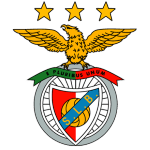
An eagle with spread wings stands above a ribbon carrying the motto E pluribus unum (out of many, one), over a red-and-white shield with the initials S.L.B. on a football, all set on a silver bicycle wheel. Three gold stars above the eagle, worn on the club’s shirts, each stand for ten league titles. The founders of Sport Lisboa chose the eagle, the motto and the football in 1904, and the wheel came in 1908, when the club merged with Grupo Sport Benfica, whose main sport was cycling. This drawing dates from 1999. On 31 October 2026 the club presented an update, with a gold wheel and the eagle gripping the ribbon, to appear first on membership cards and then gradually elsewhere.
Quiz clue: A gold eagle with spread wings under three gold stars, above a red-and-white shield on a silver wheel. Santa Clara’s crest resembled it until 2024.
Braga
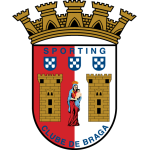
The crest is based on the arms of the city of Braga. It shows the Virgin Mary holding the infant Jesus between two towers, with three small Portuguese shields above her and a gold mural crown with five towers on top. The city arms have a blue field, but the club made it red and white and turned the towers gold. SPORTING is written across the top and CLUBE DE BRAGA along the bottom. The red and white also explain the nickname: in the mid-1940s the club adopted a kit copied from Arsenal.
Quiz clue: A red-and-white shield with the Virgin and Child between two gold towers under a gold mural crown. Porto’s crest also has a crown, but sits on a blue ball.
Casa Pia
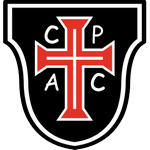
A red-and-white Cross of the Order of Christ fills a black shield, with the letters C, P, A and C in white around it, for Casa Pia Atlético Clube. Black is the club’s colour, and the first Portugal national team played in black, in kit lent by Casa Pia. The club was founded in Lisbon on 3 July 1920 and is named after Casa Pia, the children’s charity where co-founder Cândido de Oliveira grew up. The early badges were oval, and the shield shape came later.
Quiz clue: A black shield with a red-and-white cross and the letters CPAC in its corners. Académico de Viseu’s shield is also black but has only initials.

Estoril Praia
The badge is a downward-pointing triangle edged in yellow. At the top a yellow sun rises with its rays spread over a blue sky, and below it the letters GDEP, for Grupo Desportivo Estoril Praia, are drawn as a linked monogram. The colours come from the coast: yellow for the sun and blue for the Atlantic. The club was founded on 17 May 1939 as Grupo Desportivo Estoril Plage. Its yellow-and-blue kit, a nod to Brazil’s national team, gave the team the nickname Canarinhos.
Quiz clue: An upside-down yellow-edged triangle with a rising sun and a GDEP monogram on blue.

Estrela da Amadora
The club’s statutes define the badge: a yellow five-pointed star over three equal vertical stripes in red, white and green, inside a shield, with the letters CFE in yellow above the star and an A below it. Estrela means star. The club took red, white and green in 1951, after visiting representatives of Fluminense from Rio de Janeiro gave it three kits and the members decided to adopt the same colours. The present club was formed in 2020 by a merger that revived the identity of the original club, founded in 1932.
Quiz clue: A yellow star on red, white and green vertical stripes, with CFE above the star and A below.
Famalicão
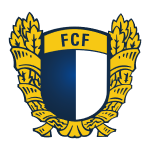
The club’s statutes set the crest: a shield with a blue-and-white field, a band across the top carrying the initials FCF, and a laurel wreath around it. Because the design is fixed in the statutes, changes over the years have been limited to modernising the drawing. The club was founded on 21 August 1931 and first wore green and white. In 1938 it switched to blue and white, hoping to become affiliated with FC Porto.
Quiz clue: A shield split into dark blue and white under an FCF band, wrapped in a laurel wreath.
Gil Vicente
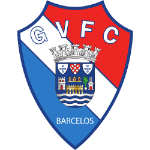
The centre of the badge is the coat of arms of Barcelos, under a mural crown, with BARCELOS written beneath. Around it the shield is split diagonally in red, white and blue, with the initials GVFC across the top. The club used the city arms from its foundation in 1924. From 2005 it used a badge built around the rooster, its mascot, until members voted on 8 June 2021 to return to the older design in modernised form. The club is named after a theatre near where the founders met, itself named after the playwright Gil Vicente.
Quiz clue: A red, white and blue diagonal shield with GVFC across the top and a crowned town coat of arms in the middle.
Marítimo
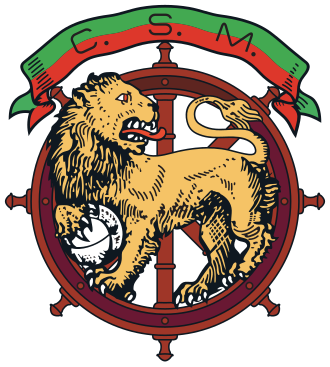
A tan lion stands in front of a ship’s wheel with a paw on a football, below a green-and-red ribbon with the initials C.S.M. José Inês Ramos, a designer at a Funchal embroidery house, drew this crest in 1916–17. The wheel kept the club’s maritime roots, after a first badge made up of an oar, a buoy, a harpoon and an anchor. The club adopted a modern version in 1999, and in 2022 brought the classic crest back for all its teams. Green and red come from the flag of the new Portuguese Republic of 1910.
Quiz clue: A tan lion with a paw on a football, in front of a ship’s wheel under a green-and-red ribbon. Sporting’s lion is white and stands on a green shield.
Moreirense
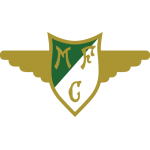
The badge is a small pointed shield, split diagonally into green above and white below, carrying the letters M, F and C for Moreirense Futebol Clube. A pair of gold wings spreads out on either side, which gives the badge its wide shape. Green and white are the club colours, and the home shirt is traditionally green-and-white checks. The club was founded on 1 November 1938 in Moreira de Cónegos, in the municipality of Guimarães, which the nickname Cónegos echoes.
Quiz clue: A green-and-white shield with MFC between a pair of wide gold wings.
Nacional
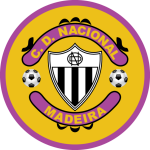
A yellow disc holds a white shield crossed by three black vertical stripes, in the club’s black-and-white colours. In the white band at the top of the shield is a small black monogram of the letters CDN. Two footballs sit either side, and coloured scrolls carry the words C.D. NACIONAL above and MADEIRA below. The club was founded in Funchal on 8 December 1910 as Nacional Sport Grupo, chose black and white at its founding, and took its present name, Clube Desportivo Nacional, in 1922.
Quiz clue: A black-and-white striped shield between two footballs on a yellow disc, with MADEIRA written below.
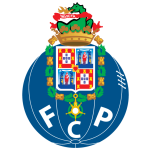
Porto
The crest joins two badges. The first, a blue football with the white initials FCP, still forms the lower part. On 26 October 1922 the club approved a new design by Augusto Baptista Ferreira, known as Simplício, an artist who also played for the club. He set the coat of arms of the city of Porto above the old ball. The shield is ringed by the collar of the Order of the Tower and Sword, and on top sit a crown and a dragon with a ribbon reading Invicta, the unconquered, a name given to the city. Since then only the drawing and colours have been adjusted.
Quiz clue: A blue ball marked FCP below a quartered city shield, with a dragon perched on a crown at the top.
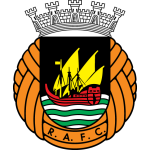
Rio Ave
The badge is an old-style panelled football with the initials R.A.F.C. on it, and the coat of arms of Vila do Conde laid over the top. The arms show a sailing ship with yellow sails on green-and-white waves, on a black shield under a mural crown. The club is named after the River Ave, which flows through Vila do Conde into the Atlantic, and its home shirts have green and white stripes. It was founded on 18 January 1939.
Quiz clue: A sailing ship on a black shield, laid over an orange panelled ball marked RAFC.
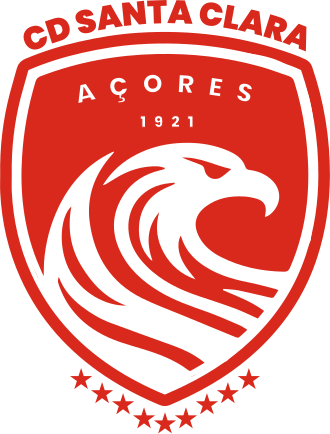
Santa Clara
A large white head of a milhafre, a bird of prey that is a symbol of the Azores, fills a red shield. Above it are the club name, the word AÇORES and the founding year, 1921, and nine stars below stand for the nine islands of the archipelago. Members chose this design by Sérgio Marques at an extraordinary general assembly in March 2024, and it has been on the shirt since the 2024–25 season. The club changed its crest because the old one resembled Benfica’s and tied it to that club, and it wanted an identity of its own.
Quiz clue: A white bird of prey’s head on a red shield, with nine small stars below. The old crest resembled Benfica’s.
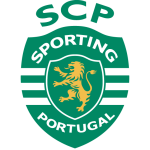
Sporting CP
A white rampant lion stands on a green shield, with the letters SCP above it in place of a crown. The lion comes from the arms of Dom Fernando de Castelo Branco, who allowed the club to use it in 1907. The current crest, the sixth in the club’s history, was unveiled on 1 July 2026, the club’s 120th anniversary. Designed by the agency JKR, it is based on the 1945 crest. The lion returns to white after 25 years in gold, and its tail is drawn to form an S for Sporting.
Quiz clue: A white lion on a plain green shield under bold SCP letters. Marítimo’s lion is tan, stands in front of a ship’s wheel and has a paw on a ball.

Vitória de Guimarães
The central figure is Afonso Henriques, the first king of Portugal, standing on a pedestal in armour with a sword and shield. The shield behind him is split diagonally into black and white, with the club name running down the left and the interlaced letters SC on the right. The first emblem was designed in the late 1920s by Captain Mário Cardoso, for many years president of the Sociedade Martins Sarmento. White and black were chosen to show that the club admitted everyone, without distinction.
Quiz clue: A black-and-white shield with a standing armoured king on a pedestal and a curly SC monogram.
Sources
Each entry was checked against the club’s official website or its Wikipedia article in November 2026. Crests are trademarks of their clubs and appear here only to identify them.
- Académico de Viseu: pt.wikipedia.org
- Académico de Viseu: academicodeviseu.pt
- Alverca: www.fcalverca.pt
- Alverca: pt.wikipedia.org
- Alverca: en.wikipedia.org
- Arouca: en.wikipedia.org
- Arouca: www.fotw.info
- Arouca: pt.wikipedia.org
- Arouca: www.abola.pt
- Benfica: en.wikipedia.org
- Benfica: pt.wikipedia.org
- Benfica: www.footyheadlines.com
- Benfica: www.footyheadlines.com
- Benfica: www.flashscore.pt
- Braga: pt.wikipedia.org
- Braga: en.wikipedia.org
- Casa Pia: pt.wikipedia.org
- Casa Pia: en.wikipedia.org
- Estoril Praia: pt.wikipedia.org
- Estoril Praia: en.wikipedia.org
- Estrela da Amadora: estrelamadora.pt
- Estrela da Amadora: pt.wikipedia.org
- Famalicão: pt.wikipedia.org
- Famalicão: en.wikipedia.org
- Gil Vicente: pt.wikipedia.org
- Gil Vicente: en.wikipedia.org
- Marítimo: pt.wikipedia.org
- Marítimo: en.wikipedia.org
- Marítimo: www.dnoticias.pt
- Moreirense: pt.wikipedia.org
- Moreirense: en.wikipedia.org
- Nacional: www.fotw.info
- Nacional: pt.wikipedia.org
- Nacional: en.wikipedia.org
- Porto: pt.wikipedia.org
- Porto: en.wikipedia.org
- Rio Ave: www.fotw.info
- Rio Ave: en.wikipedia.org
- Santa Clara: bolanarede.pt
- Santa Clara: www.noticiasaominuto.com
- Santa Clara: www.abola.pt
- Santa Clara: www.abola.pt
- Sporting CP: pt.wikipedia.org
- Sporting CP: en.wikipedia.org
- Sporting CP: www.abola.pt
- Vitória de Guimarães: pt.wikipedia.org
- Vitória de Guimarães: en.wikipedia.org